Archive·tdd.cat
Sunday, July 26, 2026
101 Stories

The Daily Diff

Papers and Threads Worth Your Time

  /\_/\
 (=^.^=)
 (")_(")
				
  /\_/\
 (=^.^=)
 (")_(")
				

Source
Signal

No stories match the selected filters in today's edition.

OpenLake delivers million-plus IOPS for LLM inference and GPU training

OpenLake delivers million-plus IOPS for LLM inference and GPU training

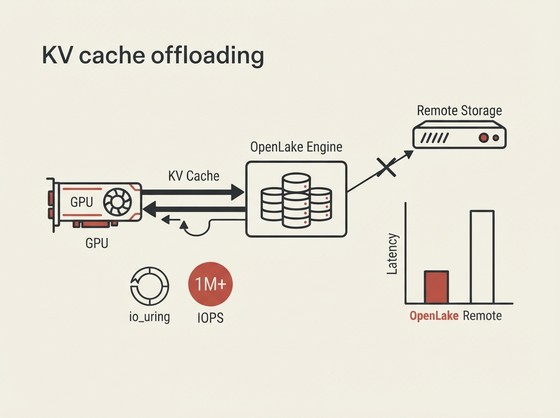
Cutting LLM inference costs by 50 percent is now a tangible reality with external KV cache offloading. OpenLake, a new high-performance storage engine, tackles this by leveraging Rust and io_uring to deliver over a million IOPS within 1ms.

This is not just an incremental gain; it is a fundamental rethinking of how LLM key-value caches are managed. By co-locating petabyte-scale KV cache storage directly on GPU hosts, OpenLake keeps your accelerators fed, drastically reducing idle time during training and inference. This level of persistent, durable cache performance for GPU workloads is a game changer for anyone running serious LLM infrastructure.

Stop letting your GPUs starve. This architecture will redefine your LLM operational costs and throughput.
SHACKLE protocol enables runtime circuit breaking for autonomous AI agents

SHACKLE protocol enables runtime circuit breaking for autonomous AI agents

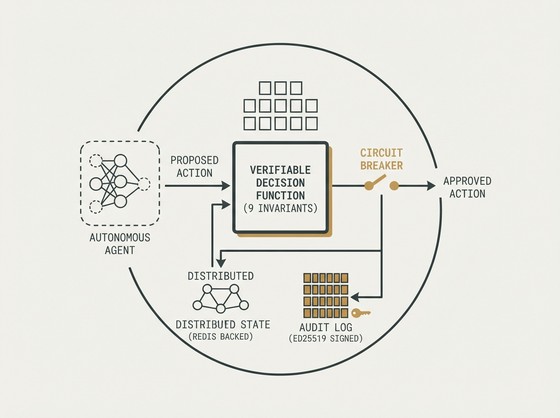
Deploying autonomous AI agents in production introduces significant safety and control challenges. SHACKLE SP/1.0 addresses this head-on by proposing a runtime circuit breaker that provides deterministic and reproducible verdicts for agent decisions.

This is not just a theoretical idea; the protocol specifies nine mathematical invariants, ensuring rigorous, verifiable decision-making. It incorporates Ed25519-signed append-only audit logging and uses a Redis-backed distributed state engine, making it robust and scalable for real-world deployments.

If you are building or planning to deploy sophisticated AI agents, understanding this specification is paramount. It offers a blueprint for implementing crucial guardrails, ensuring agents operate within defined boundaries and providing the auditability needed for responsible AI systems. This is fundamental for robust agentic AI infrastructure.

PGSimCity visually explains how PostgreSQL actually works

PGSimCity visually explains how PostgreSQL actually works

Struggling to visualize complex PostgreSQL internals? PGSimCity offers a remarkably novel and engaging solution: an explorable 3D city that brings core database mechanisms to life. You can literally walk through a PostgreSQL cluster and interactively observe its behavior.

This project transforms abstract concepts into tangible experiences. You will see firsthand why a checkpoint operation can spike latency, understand the specific mechanisms through which a forgotten long-running transaction leads to table bloat, and finally grasp the true performance costs associated with synchronous_commit. It serves as a powerful, interactive debugger for your database knowledge.

For any senior backend engineer working deeply with Postgres, this represents an unparalleled learning resource. It converts theoretical database knowledge into concrete, actionable insights that will directly inform your system design, performance tuning, and operational troubleshooting strategies.

A Deep Technical Walkthrough of LLM Inference Process

A Deep Technical Walkthrough of LLM Inference Process

The inner workings of LLM inference are often shrouded in abstraction, leaving many engineers with a “and then magic happens” understanding. This deep technical walkthrough rips away the mystery, detailing every step from your prompt hitting the server to the model generating its response.

Authored by a veteran distributed systems engineer, this guide promises no skipped steps. You will trace the journey of data from bytes, to tokens, to embeddings, and through the attention mechanisms, gaining a true principal-level understanding of what really impacts performance.

For anyone building or operating systems that leverage large language models, this is indispensable. You will learn to reason about real-world production problems, pinpoint bottlenecks, and optimize your LLM infrastructure effectively.

Achieving cross-platform native code portability with a unified executable format

Achieving cross-platform native code portability with a unified executable format

This project redefines what “portable executable” means, allowing a single C/C++ binary to run on Linux, macOS, Windows, FreeBSD, OpenBSD, NetBSD, and even boot from the BIOS. This is not merely cross-compilation; it is a unified binary format that the various operating systems can interpret.

The core idea leverages the quirks of different binary loaders (ELF, Mach-O, PE) and even the legacy BIOS boot process, synthesizing them into a single file. This eliminates significant DevOps toil for CLI tools, offering high-performance native code with the deployment simplicity of web apps.

Engineers building system-level tools or command-line utilities will find immense value in understanding this approach, which simplifies distribution and broadens reach without virtual machines or complex build matrixes.

X OS is a microkernel operating system for the AI era

X OS is a microkernel operating system for the AI era

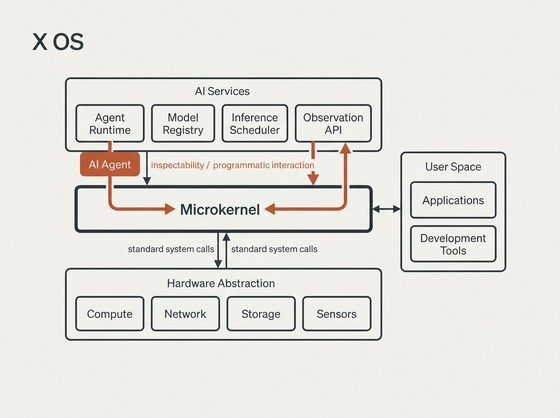
Imagine an operating system built from the ground up, not just for humans, but for intelligent AI agents. X-OS is tackling this by designing a microkernel OS where agentic programming, inspectability, and programmatic interaction are first-class architectural principles.

This is a fundamental re-think of what an OS should be in the age of AI. Instead of layering AI tools on top of an existing kernel, X-OS integrates these needs at the deepest level, making every service inspectable and every component replaceable.

This project offers a glimpse into future system design, challenging traditional assumptions and providing a fresh perspective on how human-AI collaboration can be architecturally enabled. You will gain valuable insights into designing systems where AI is not just a user, but a core participant.

PostgreSQL often sufficient for common problems, avoid complex solutions

PostgreSQL often sufficient for common problems, avoid complex solutions

Stop reaching for a new specialized database every time a problem arises. “All you need is PostgreSQL” makes a compelling case for leveraging the full power of Postgres to build robust, scalable systems, counteracting common architectural cargo culting.

This article dives deep into practical applications: implementing state machines with constraints, comprehensive account auditing via immutable events, and optimizing for both OLTP and OLAP workloads. It details how to enable HOT Updates for write throughput, ensure serializable isolation, and maintain business rules purely within the database.

You will learn to maximize PostgreSQL’s capabilities for high performance and reliability, reducing system entropy and operational risk by consolidating data management. This changes how you think about system design, promoting elegant simplicity over unnecessary complexity.

ATLAS automates per-layer FHE configuration for transformer inference

ATLAS automates per-layer FHE configuration for transformer inference

Deploying transformer models with homomorphic encryption (FHE) for privacy has been prohibitively expensive, often due to manual and uniform approximation settings. This changes now.

ATLAS, a new automated framework, can configure per-layer approximation settings for transformer non-linear operations in just one hour. This tackles an exploding search space problem and dramatically cuts FHE inference costs.

This is a huge leap for practical, private AI inference, enabling real-world applications where data privacy is paramount. This work moves secure AI from theoretical to deployable.

Frozen language models leverage verified memory for deterministic, zero-token answers

Frozen language models leverage verified memory for deterministic, zero-token answers

Improving LLMs today usually means expensive retraining, leading to opaque models and non-deterministic outputs. What if we took the opposite approach: freeze the model and augment it with a persistent memory of verified solutions?

This paper introduces a system where, once a problem family is solved and independently verified, all future instances are answered with zero generation tokens, bit-exact, and deterministically. It is a 12B model that outperforms frontier models on verified work, achieving 100 percent accuracy on 180 instances across nine problem families.

This architecture offers immense practical benefits for LLM infrastructure: 1.4 microsecond memory selection, 6-23 milliseconds for a full reuse, and a massive 6,000,000-token movable context window on a single 46GB GPU, far exceeding current engines like vLLM. It is a paradigm shift for reliable, cost-effective, and scalable LLM applications.

Decker builds on HyperCard's legacy with modern improvements

Decker builds on HyperCard's legacy with modern improvements

Decker is not just another interactive document platform; it rethinks how we build simple applications, taking cues from the legendary HyperCard but adding a truly modern twist. It introduces ‘Lil’, a custom scripting language that is a fascinating blend of Lua’s imperative power and Q’s functional elegance, complete with an embedded SQL-like query system.

Imagine a language where scalar-vector arithmetic is implicit, making data manipulation remarkably concise, all within a self-contained HTML document. This approach offers a fresh perspective on DSL design and how expressive, powerful tools can be crafted for specific problem domains.

For engineers interested in programming language design or alternative ways to integrate data querying into applications, Decker offers a treasure trove of ideas. It shows how deliberate architectural choices can lead to highly capable and delightful user experiences, breaking free from common paradigms.

Progress in LLM music recommendation depends on runtime error correction

Progress in LLM music recommendation depends on runtime error correction

LLM agents in production face unique challenges beyond just the model’s intelligence. NetEase Cloud Music’s Melo agent for music recommendation tackled real-world problems like entity hallucination and long-tail degradation not by making the LLM ‘smarter’, but by building robust runtime machinery around it.

They developed inference-time entity grounding, which repurposes their production search index as a verification primitive, and reflective retry, where the system verbalizes failure reasons and feeds them back into the next planning step. This allows the agent to relax or revise constraints rather than fail blindly.

Online A/B tests showed significant lifts in playlist retention (+2pp) and engagement (+1 minute), directly attributable to these mechanisms. The paper emphasizes that reliable ‘runtime machinery’ is as crucial as the LLM itself for production success.

This insight shifts the focus from chasing model perfection to designing resilient, self-correcting systems for real-world AI agent deployments.

Understanding interventions for music recommender feedback loops

Understanding interventions for music recommender feedback loops

Recommender systems often fall into a feedback loop, continuously pushing popular items and inadvertently burying new releases or long-tail content. YouTube Music shares their hard-won empirical lessons on how to break this cycle in a production environment.

Their extensive A/B tests revealed that simple serving-time interventions are quickly neutralized by continuous model training; the system learns to ignore them. You cannot simply tweak the outputs and expect lasting change.

More effective approaches included architectural debiasing, which improved diversity but did not inherently create discovery. The most significant lift for new-release discovery came from uncertainty-driven exploration using a Spectral-normalized Neural Gaussian Process (SNGP) head, though this came with measurable engagement or diversity tradeoffs.

The key takeaway is that for large-scale, continuously trained recommenders, interventions must be deep-seated. The learning loop is powerful; combatting it requires more fundamental architectural or training adjustments.

This insight is crucial for anyone building or optimizing production-grade recommendation systems.

Ruff v0.16.0 expands default rule set for enhanced linting

Ruff v0.16.0 expands default rule set for enhanced linting

Ruff’s latest v0.16.0 release is a game-changer for Python developers, drastically expanding its default rule set from 59 to an impressive 413. This means it now catches far more issues out-of-the-box, without you needing to configure dozens of individual plugins.

Written in Rust, Ruff already replaces a whole suite of tools like Black, Flake8, and isort, executing orders of magnitude faster. This update further solidifies its position as the go-to solution for maintaining high code quality and consistency in Python projects.

For any senior engineer striving to streamline their team’s CI/CD pipelines and developer experience, adopting Ruff can mean significant gains in both speed and reliability. It is a prime example of how investing in robust tooling directly translates to tangible improvements in engineering practices.

Scriptc compiles TypeScript to small, fast native executables

Scriptc compiles TypeScript to small, fast native executables

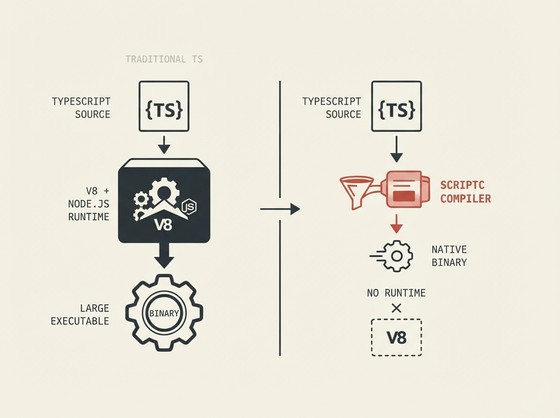
A new compiler from Vercel-labs, Scriptc, promises to revolutionize how TypeScript applications are deployed by compiling standard TS code directly to native executables. This means no more Node.js or V8 runtime embedded in your binaries.

Imagine the gains: significantly smaller executables, lightning-fast startup times, and reduced memory footprint. For serverless functions, CLI tools, or performance-critical backend services, this could be a game-changer, dramatically improving efficiency and lowering operational costs.

This is not about a new dialect or annotations; it is about taking your existing, type-checked TypeScript and delivering byte-for-byte Node-like behavior at native speeds. If you are building performance-sensitive applications with TypeScript, this is a development you should explore.

Go's go/analysis Package for Modular Static Code Inspection

Go's go/analysis Package for Modular Static Code Inspection

Building robust, maintainable codebases requires strong engineering practices, and static analysis is a cornerstone. The Go team’s go/analysis framework offers a powerful, modular way to create custom code checkers.

This framework allows you to build sophisticated analyzers that go beyond simple linting, enabling them to share semantic “facts” across packages. This means a checker can understand how code in one module affects another, similar to how a compiler works across compilation units.

For Go developers, this means the ability to create highly intelligent custom tools that integrate seamlessly into go vet, IDEs, or custom build systems. For any engineer, it is a masterclass in designing effective, extensible tooling.

Token Relay Market Drives Massive Discounts and Widespread Fraud

Token Relay Market Drives Massive Discounts and Widespread Fraud

There is a sophisticated underground market reselling LLM tokens at discounts of up to 97.8% through relay services, leading to millions in daily losses for AI gateway providers. This is not just free-credit abuse; it is a full-fledged economic attack.

The article details a four-layered ecosystem, from merchants sourcing raw accounts to the relay operators who proxy traffic, often using compromised or illicitly obtained credentials. Understanding these fraud patterns is critical for any engineer building or securing AI infrastructure.

This deep dive into LLM token fraud provides actionable intelligence, revealing specific providers and their methods. It is an eye-opening look at the dark side of the AI economy and a must-read for anyone concerned with the security and cost efficiency of their AI deployments.

Claude Code hardcodes no subagents for Opus 5

Claude Code hardcodes no subagents for Opus 5

You might assume an advanced LLM like Claude Opus 5 is free to strategize with subagents, but a recent finding reveals a fascinating constraint: Claude Code has a hardcoded instruction explicitly telling Opus 5 not to use subagents.

This is a powerful insight into prompt engineering and agentic control. It suggests that even sophisticated models are heavily guided, or restricted, by developer-imposed directives, possibly to control complexity, ensure safety, or maintain predictable behavior.

For anyone building AI agents, understanding these internal guardrails is critical. It underscores that optimal performance often comes not just from raw model power, but from precise context and constraint engineering. Sometimes, less (agency) is intentionally more.

HARTOS is an AI-native OS for local, federated model execution

HARTOS is an AI-native OS for local, federated model execution

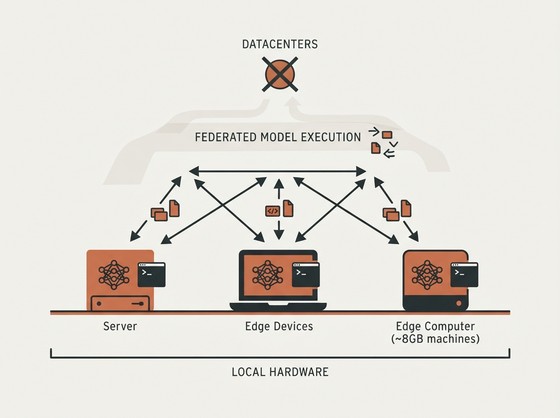
This project is rethinking AI infrastructure from the ground up, moving beyond the datacenter-centric model. HART OS is an open-source AI-native operating system that lets frontier AI models run on local hardware and federate peer-to-peer, bypassing the need for central brokers.

Think about the implications: models running efficiently on 8GB machines, with an OpenAI-compatible API, and their own Wayland compositor. This is not just a library; it is a full operating system stack designed for decentralized AI.

This challenges the prevailing wisdom that powerful AI always requires massive, centralized compute. It presents a genuinely novel architectural trade-off, prioritizing local autonomy and federation.

If you are exploring new paradigms for applied AI, edge deployments, or truly distributed agent systems, dive into HART OS. It could significantly shape how you approach future AI system designs.

A 6502 CPU built from discrete transistors precisely replicates the original die

A 6502 CPU built from discrete transistors precisely replicates the original die

Ever wondered what a CPU looks like at the transistor level, truly? This project does not just simulate it, it builds it. A fully functional 6502 CPU, the heart of classics like the Apple II and Commodore 64, meticulously recreated using 4,051 discrete transistors.

Every tiny SOT-323 package on this A4-sized board corresponds to a single transistor on the original silicon die, laid out precisely according to the 6502’s actual floorplan. This is not an emulation; it is the real dynamic NMOS circuit running the same instructions, just thousands of times larger and slower.

This physical manifestation of computer architecture offers an unparalleled glimpse into the foundational hardware our software runs on. It is a stunning blend of engineering artistry and deep computer science, providing a concrete understanding of how a classic processor truly works.

Optimizing AI token usage to reduce waste and cost

Optimizing AI token usage to reduce waste and cost

Building production-grade AI agents means mastering tokenomics. It is not just about raw API costs, but about intelligent context management, caching, and routing to prevent token waste and boost performance.

This “awesome list” goes deep into how real projects are tackling token efficiency. You will find concrete strategies for context engineering, compression, and memory management that can drastically reduce inference costs and improve agent effectiveness. Think specific practices and copy-paste setups, not just high-level theory.

A key takeaway here is that more context does not always mean smarter agents; often, it means more distraction and higher costs. Learning to trim and target context is a core skill.

If you are building with LLMs and agents, this resource is a goldmine for actionable insights.

Ailin achieves reliable collective intelligence through diverse AI model collaboration

Ailin achieves reliable collective intelligence through diverse AI model collaboration

The future of AI is not just about bigger models, but smarter collaboration. Ailin presents an open-source collective intelligence engine that allows thousands of AI models to work together, employing diverse coordination strategies to boost reliability, auditability, and resilience.

This project tackles a fundamental challenge in multi-agent systems: how to effectively orchestrate independent AI entities to achieve complex goals without sacrificing robustness. By emphasizing structured diversity and independent reasoning, Ailin provides a compelling blueprint for designing AI systems that are more than the sum of their parts.

Engineers working on advanced AI applications or looking into the architecture of large-scale agentic systems will find this a deep dive into the next generation of applied AI. This could reshape how we build and deploy intelligent systems.

Ship APIs exposing core functionality before building AI interfaces

Ship APIs exposing core functionality before building AI interfaces

In the rush to integrate AI, many companies are building product-specific AI chat features. This piece argues for a different, more foundational approach: prioritize shipping well-designed, accessible APIs with robust permissions and human-in-the-loop hooks first.

The core insight is that your AI agents are only as good as the tools they can access. When core functionality is locked behind a UI, it severely limits what agents can achieve. Building an excellent API means thinking deeply about token efficiency, fine-grained control, and extensibility

This is not just about better engineering; it is about strategic longevity. By providing infrastructure that AI can leverage, you position your company to thrive as AI agents become the primary interface. Think infrastructure, not just features.

Securing the AI-native software development lifecycle with AI code authorship

Securing the AI-native software development lifecycle with AI code authorship

Anthropic’s software development lifecycle is 80 percent AI-authored. This is not just an an efficiency gain, it is a paradigm shift in engineering practice and security posture. Their security team now defends a constantly evolving surface area with non-deterministic agents at its core.

This means addressing threats like prompt-injected agents introducing malicious changes or supply-chain poisoning that an agent ingests. Scaling security processes alongside exponential code velocity (engineers ship 8x more code) requires rethinking traditional SDLC security.

They are using their Zero Trust for Agents framework to manage this, focusing on directing agent intent and human final approval. This offers invaluable insights into the future of engineering when AI moves beyond assistants to primary creators.

Local-first skill router avoids large agent model context flooding

Local-first skill router avoids large agent model context flooding

Building AI agents with extensive tool use often hits a wall: the context window limit. How do you give your agent hundreds of skills without overwhelming the LLM and skyrocketing token costs?

The Skill Router offers an elegant, local-first solution. It indexes only metadata for a vast library of skills in SQLite, keeping just a tiny interface skill in the agent’s active context. When a task requires a specific capability, the router performs a bounded search, selects the best match, and loads only that skill’s full body on demand.

This means your agents gain access to an almost unlimited toolset without sacrificing performance or token efficiency. It is a crucial architectural pattern for scaling complex agentic systems.

The Jac Programming Language

The Jac Programming Language

Building complex AI agents often feels like trying to fit a square peg into a round hole with traditional languages. Enter Jac, a new hybrid AI and general-purpose programming language with native Agent-Oriented Programming (AOP).

Jac is not just another language; it is purpose-built for efficient, scalable AI applications, particularly for constructing, managing, and orchestrating sophisticated multi-agent systems. Its design decisions stem from the core challenges of agent development, rather than retrofitting existing paradigms.

This could be a game-changer for engineers deep into applied AI and agentic systems. You will want to investigate its native AOP support and how it simplifies the architecture of autonomous agents. A new tool designed specifically for your toughest AI problems is worth your time.

Actenon Scan detects unauthorized consequential actions by AI agents

Actenon Scan detects unauthorized consequential actions by AI agents

Building AI agents is exciting, but securing them is paramount. Actenon Scan offers a crucial safety net: it statically analyzes your agent framework’s code to pinpoint where model-controlled input could trigger destructive actions

This tool is a game-changer for agent safety. It helps identify critical vulnerabilities that could allow an LLM to bypass guardrails and execute unintended, high-impact operations. Supporting Python, TypeScript, and Go, it offers a zero-dependency SAST solution for the burgeoning agent ecosystem.

For any engineer developing or deploying AI agents, understanding and mitigating these risks is no longer optional. This is not just theoretical security; it is about preventing real-world catastrophic failures from autonomous actions.

Hallmark enables distinct AI design output avoiding typical templates

Hallmark enables distinct AI design output avoiding typical templates

Producing truly original UI designs with AI has been a challenge; the output often feels generic or “slop-like.” This project introduces a novel approach to combat that.

It works by picking a unique macrostructure for each design brief, dressing it in one of twenty distinct themes, and then running fifty-seven “slop-test gates” with a pre-emit self-critique. This actively refuses the on-distribution defaults every LLM was trained into, ensuring that different briefs result in genuinely distinct sites, not just color-swaps.

This is more than just a template system; it is an intelligent framework to enforce design individuality. Engineers can use verbs like build for new UI, audit existing code against anti-patterns, or study a design to extract its “DNA” without pixel-cloning.

This offers a powerful way to leverage AI for design without sacrificing uniqueness and quality.

Cutting system prompts improves performance for small language models

Cutting system prompts improves performance for small language models

Conventional wisdom suggests that smaller, less capable LLMs need detailed, lengthy system prompts for effective performance. However, recent empirical data challenges this assumption directly.

A team experimented with significantly cutting an agent’s system prompt by 80 percent, from approximately 34,000 to 18,000 characters, on a genuinely small model, deepseek-v4-flash. The results were surprising.

Not only did the shorter prompt reduce input tokens by a substantial 32 percent, leading to lower costs, but it also improved the mean reward and increased the number of tasks passed on an 89-task benchmark suite. This suggests that even smaller models can benefit from less explicit direction.

This finding has significant implications for prompt engineering. It indicates that context overload might be detrimental even for models believed to require extensive hand-holding, urging engineers to prioritize conciseness for better performance and efficiency in agentic systems.

Wattage detects, prices, and prevents AI agent token waste

Wattage detects, prices, and prevents AI agent token waste

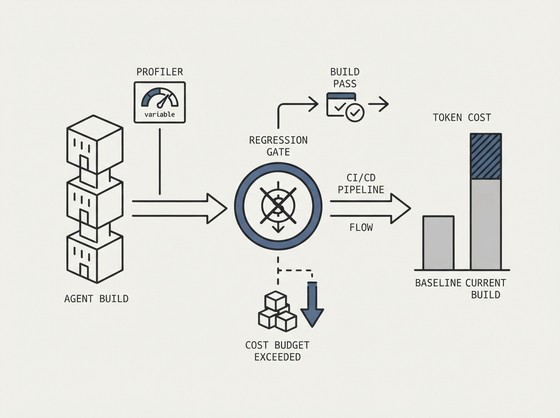
Building AI agents often means battling unpredictable token costs and subtle regressions. A new tool called Wattage offers a critical solution: a token-spend profiler and cost-regression gate.

Imagine pointing a tool at your agent’s trace and instantly seeing where tokens are burned, wasted, and the real dollar cost of those inefficiencies. Wattage does precisely this, even identifying stable prompt prefixes being resent instead of cached, then prices the waste and prescribes a fix.

This is not just about awareness; it is about control. Wattage allows you to integrate cost regression into your CI/CD pipeline, failing builds when a change makes your agent measurably more expensive. It helps prevent costly surprises and drives a culture of token efficiency.

If you are building LLM-powered systems, this is a practical blueprint for operational excellence. Stop flying blind on costs and start engineering for efficiency.

Nushell simplifies shell interactions with structured data and powerful features

Nushell simplifies shell interactions with structured data and powerful features

Tired of shell scripts failing because a grep output format changed? Nushell is here to save your day by treating everything as structured data, not just plain text. This fundamental shift eliminates an entire class of brittle string parsing errors that plague traditional Unix pipelines.

Imagine piping JSON, YAML, or database query results directly as objects, then filtering and selecting properties without awkward jq or awk invocations. Nushell offers type safety and robust error handling, catching issues earlier and making your scripts significantly more reliable.

For any senior engineer who spends time on the command line or writing operational scripts, exploring Nushell can genuinely enhance productivity and the robustness of your automated workflows. It is a powerful evolution for your terminal.

AI agents' excessive tool calls for simple greetings cause tokenflation

AI agents' excessive tool calls for simple greetings cause tokenflation

Have you noticed your AI agents

overthinking

simple tasks, racking up costs and latency? This phenomenon, dubbed

tokenflation,

is a real challenge for production AI systems, and new benchmarks reveal just how bad it can get.

A trivial

Hi

prompt can trigger an agent to perform dozens of unnecessary tool calls

inspecting repositories, running applications, and even attempting unsolicited code commits. Some models wasted significant time and money just to respond to a greeting. This is not just about token cost; it is about the precious human time lost waiting for an agent to finish its elaborate internal monologue.

This empirical analysis provides concrete data on model behavior, showing that not all agents are created equal when it comes to efficiency. Understanding this

tokenflation

is crucial for optimizing your agent designs and ensuring they deliver actual value without unnecessary overhead.

Go's Green Tea garbage collector struggles with sparse pages

Go's Green Tea garbage collector struggles with sparse pages

Go 1.26’s new Green Tea garbage collector is not just an incremental update; it changes how memory is managed. This deep dive visualizes its cache-friendliness with perf, offering a rare look into heap allocation patterns.

The non-moving collector, while performant in many areas, still grapples with reclaiming sparse pages effectively. Understanding these trade-offs is crucial for any senior engineer optimizing Go applications.

You will gain concrete insights into Go’s runtime and memory management, moving beyond high-level concepts to actionable knowledge.

Triton brings DirectX 11 support to QEMU Windows virtual machines

Triton brings DirectX 11 support to QEMU Windows virtual machines

Achieving modern DirectX 11 graphics acceleration in QEMU for Windows guests is a monumental engineering feat, and Triton delivers. This new DirectX 11 driver, paired with the Neptune protocol forwarding layer, serializes Direct3D API calls across the hypervisor boundary.

This is not just about running Wine games faster; it is about bringing full, smooth desktop experiences to virtualized Windows environments. The team tackled the challenge of efficiently moving GPU images across the hypervisor without performance penalties from the window compositor.

This work showcases a deep dive into VirtIO, custom driver development, and the intricate dance between host and guest systems for high-performance graphics. Truly a masterclass in low-level systems integration.

Go TLS Authenticates with TPM Key That Never Leaves Hardware

Go TLS Authenticates with TPM Key That Never Leaves Hardware

Securing your Go applications with mTLS just got a significant upgrade, especially for those worried about key exfiltration. This Go library integrates Trusted Platform Modules (TPMs) directly into crypto/tls for authentication.

Imagine: your TLS private keys never leave the hardware. When Go’s crypto/tls needs a signature for a handshake, the TPM handles it internally. This design eliminates the most common vector for key compromise – process memory leaks.

The project provides a crypto.Signer implementation that leverages existing TPM keys, making it highly practical for hardening infrastructure without needing to redesign core cryptographic primitives. This is a game-changer for high-assurance environments.

It is about building trust from the silicon up.

Kaappi is a comprehensive Scheme implementation built in Zig

Kaappi is a comprehensive Scheme implementation built in Zig

Dive deep into low-level systems engineering with Kaappi, a complete R7RS-small Scheme implementation written in Zig. This is not just another language project; it is a masterclass in building a high-performance runtime from the ground up.

Kaappi features a register-based bytecode VM, a generational garbage collector, stack-copying first-class continuations, an LLVM native-code backend, and a C FFI. The project demonstrates exceptional technical rigor in areas crucial for database internals, operating systems, and high-performance computing.

What makes it even more compelling is the explicit mention of AI assistance in its development. This provides a tangible example of how advanced AI tools can be leveraged to tackle incredibly complex engineering challenges, offering insights into the future of software development workflows. This is a must-see for anyone interested in programming language internals or AI-assisted development.

CodeGraph improves AI agent efficiency with pre-indexed knowledge

CodeGraph improves AI agent efficiency with pre-indexed knowledge

The core challenge with advanced AI coding agents often is not the model itself, but providing the right context efficiently. Codegraph offers a compelling solution: a pre-indexed, auto-syncing code knowledge graph, powered by Rust, that delivers “surgical context” to agents.

This means fewer wasted tokens, more precise tool calls, and ultimately, a higher success rate for your coding agents. It tackles the fundamental problem of how to give an LLM just the signal it needs without overwhelming it with noise.

Engineers building agentic systems often struggle with context window limitations and irrelevant information. Codegraph’s approach promises to make these systems far more practical and performant in real-world development environments.

This could be a game-changer for developer productivity leveraging AI.

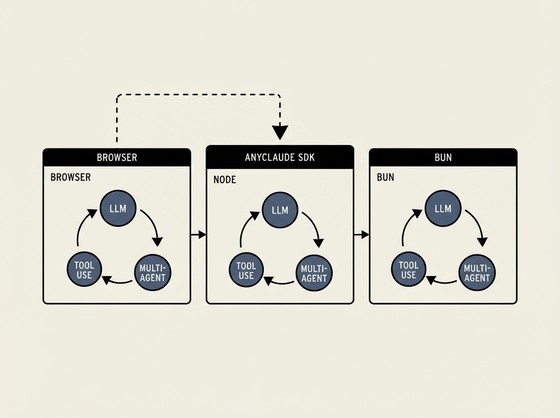
AnyClaude SDK enables agent capabilities for any LLM without a backend

AnyClaude SDK enables agent capabilities for any LLM without a backend

Building robust AI agents often requires sophisticated orchestration, especially for tool use and multi-agent setups. The Anyclaude-SDK offers Claude-like agent capabilities of-the-shelf for any OpenAI or Anthropic-compatible LLM.

Crucially, it supports running these complex agent architectures directly in the browser (via WebContainer), Node, and Bun, often without needing a separate backend. This significantly simplifies development and deployment for many agentic applications.

If you are working with multi-agent systems, tool loops, or complex conversational flows, this SDK provides a highly practical framework that abstracts away much of the underlying complexity and offers unprecedented client-side flexibility.

Forkbench provides mission control for concurrent coding agents

Forkbench provides mission control for concurrent coding agents

Managing multiple AI coding agents has always been a messy terminal juggling act; Forkbench offers a native Mac solution to bring order to agentic chaos. It provides a central control room to run, monitor, and coordinate several CLI agents simultaneously.

This tool is particularly clever in how it handles agent workspaces: each agent gets its own Git branch. This simple design choice prevents agents from clobbering each other’s work and keeps your main branch clean, a huge win for collaborative or complex agentic development. Furthermore, it emphasizes local execution, ensuring your sensitive code and API keys never leave your machine, addressing a major privacy concern with many cloud-based AI tools.

This is not just another wrapper; it is a thoughtful platform for increasing developer productivity when integrating AI into the engineering workflow, turning a swarm of agents into a coordinated team.

Bast.sh offers a native SSH picker and key manager

Bast.sh offers a native SSH picker and key manager

Tired of juggling multiple SSH configurations, keys, and host inventories across different cloud providers? Bast.sh offers a robust SSH multiplexer and key manager designed for engineers operating complex distributed systems.

This tool smartly integrates with your existing OpenSSH configuration, acting as an intelligent layer on top rather than replacing it. Crucially, it syncs with AWS, GCP, and Azure to automatically discover and manage your virtual machines, streamlining access without needing to manually update host lists. It respects your existing .ssh/config while adding valuable features.

For any senior engineer managing a fleet of remote servers, Bast reduces friction and enhances productivity, ensuring you spend less time fumbling with credentials and more time building.

KGazer provides a web interface for Kafka compacted topic exploration

KGazer provides a web interface for Kafka compacted topic exploration

Navigating Kafka compacted topics can be a real headache when you need to understand the current state of a key or its entire history. KGazer steps in as a powerful open-source solution, acting as a “time machine” for your Kafka data.

This tool continuously consumes messages, stores them in PostgreSQL, and offers a web interface that is a game-changer. Imagine searching for a key, seeing its full evolution with syntax-highlighted JSON diffs, and even visualizing a timeline of changes. It also provides consumer group monitoring and offset management, giving you a comprehensive view without needing to write throwaway scripts.

For engineers dealing with event-driven architectures and state replication, this level of visibility is not just convenient; it is essential for debugging, understanding data flow, and ensuring data integrity. It transforms a historically opaque process into a transparent and manageable one.

This is exactly the kind of open-source utility that boosts developer productivity.

Building a Production-Grade Self-Scaling OCR Pipeline on Kubernetes

Building a Production-Grade Self-Scaling OCR Pipeline on Kubernetes

Building a production-grade OCR pipeline that actually scales is hard; most tutorials stop at basic API calls. This project on GitHub provides a full blueprint for a self-scaling, event-driven Visual Document Understanding pipeline.

It integrates Qwen 3.5 (an SLM) and the GLM-OCR SDK, leveraging Rust, vLLM for inference, Redis for messaging, and KEDA on Kubernetes for auto-scaling. The focus is on throughput, robustness, and formal architecture assessment, not just text extraction.

This is a serious deep dive into applied AI, showing how to engineer a resilient, high-performance system from the ground up, moving beyond just basic functionality.

PostgreSQL extension exports real-time query telemetry to ClickHouse

PostgreSQL extension exports real-time query telemetry to ClickHouse

Standard PostgreSQL metrics are useful, but pg_stat_statements aggregates data, losing crucial per-query detail. pg_stat_ch changes this by capturing every raw query execution telemetry event directly from Postgres internals.

This extension then streams these raw events in real-time to ClickHouse, allowing for powerful analytical aggregation there. This means you can perform much deeper, custom performance analysis and identify bottlenecks with unprecedented granularity.

For anyone running high-load Postgres databases, this offers a game-changing level of insight into query performance and overall system health.

TileLang streamlines high-performance GPU and CPU kernel development

TileLang streamlines high-performance GPU and CPU kernel development

Optimizing GPU/CPU kernels for modern AI workloads is incredibly challenging, yet crucial for performance. Tile Language introduces a concise domain-specific language, built on TVM, that streamlines this process with a Pythonic syntax.

This is not just another library; it is a full compiler infrastructure designed for high-performance primitives like GEMM and FlashAttention. It lets developers focus on productivity while still enabling the low-level optimizations required for state-of-the-art performance in areas like LLM inference.

If you are wrestling with custom kernel development or trying to squeeze every ounce of performance from your AI hardware, exploring a project like Tile Language could fundamentally change your approach. It promises significant gains by abstracting complexity without sacrificing control.

Local agentic coding plugin enables iterative plan annotation and feedback

Local agentic coding plugin enables iterative plan annotation and feedback

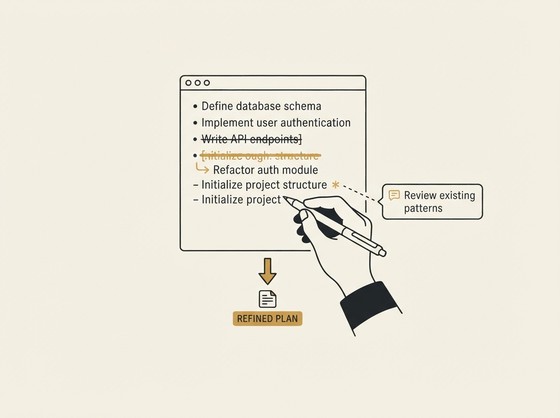
Improving agent reliability often hinges on better human feedback, and this local-first tool for annotating agent plans offers a powerful solution. It intercepts your agent’s plan, opens an interactive UI, and allows you to provide structured edits directly on the plan itself.

This is not just about correcting errors; it is about teaching and guiding the agent’s reasoning process. You can strikethrough sections, insert new lines, replace text, or add comments. This granular feedback loop transforms a vague “that is not right” into concrete, actionable instructions, enabling the agent to refine its understanding and execution.

For senior engineers tasked with leveraging AI agents for complex coding tasks, this significantly shortens the iteration cycle and ensures agents produce more aligned and effective outputs. It offers a practical way to implement human-in-the-loop validation, moving beyond simple prompt engineering to a more robust context engineering paradigm.

Replacing COBOL with Cloud Can Be Slower and Riskier Than Expected

Replacing COBOL with Cloud Can Be Slower and Riskier Than Expected

Replacing decades-old COBOL systems with modern cloud architectures often leads to slower performance, higher costs, and critical business logic loss. Enterprises spend fortunes over years only to find their new systems cannot match a mainframe’s efficiency for specific workloads.

The key challenge is often the undocumented business logic embedded in the COBOL code itself. Reverse-engineering this logic can miss obscure edge cases accumulated over forty years, leading to critical transaction failures post-migration. Mainframes excel at batch processing and heavy I/O in ways distributed microservices struggle with due to network latency.

This piece highlights that full rip-and-replace is rarely the answer. Instead, in-place modernization, such as wrapping COBOL in APIs to gradually update the edges, proves to be a more pragmatic and successful strategy. Understanding these trade-offs is crucial for any senior engineer involved in large-scale system modernization efforts.

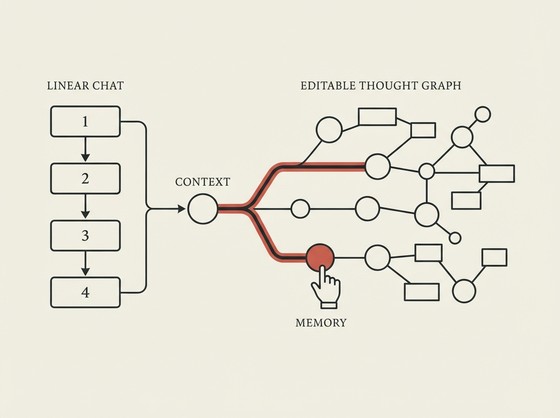
ThoughtDAG maps LLM conversations into an editable thought graph

ThoughtDAG maps LLM conversations into an editable thought graph

Imagine an LLM chat where the conversation is not a linear thread, but an editable, infinite canvas where nodes are thoughts and wires are context. This is what ThoughtDAG offers.

The core innovation here is incredibly subtle yet powerful: “wires are the context.” What the model sees is precisely what you visually connect to a node. This means directly editing the graph also edits the model’s memory, giving you unprecedented control over the LLM’s understanding and focus.

For anyone building or using AI agents, this paradigm shift in context management can dramatically improve reasoning, reduce hallucinations, and unlock more complex, multi-step problem-solving. It moves beyond prompt engineering to true context engineering.

Supervising Go's fire-and-forget goroutines prevents common pitfalls

Supervising Go's fire-and-forget goroutines prevents common pitfalls

Unmanaged go func() calls are a silent killer in Go applications, leading to resource leaks, unhandled panics, and messy shutdowns. This article unveils a robust “supervised fire-and-forget” pattern that solves these problems elegantly.

The core idea is a small worker pool backed by a buffered channel. This architecture ensures goroutines are properly managed, become cancellation-aware, and can recover from panics without crashing the entire process. It is a critical piece for building resilient concurrent systems.

This pattern is not just theoretical; it provides immediately actionable code that you can integrate into your Go services. It helps ensure your background tasks, like notifications or diagnostic logging, are both efficient and safe.

Stop letting goroutines run wild. This is essential knowledge for building high-quality, stable Go applications.

Choosing boring technology improves engineering and developer satisfaction

Choosing boring technology improves engineering and developer satisfaction

The allure of shiny new technology is strong, but Dan McKinley’s “Choose Boring Technology” makes a compelling, enduring argument for why maturity wins. This is not about shunning innovation; it is about strategic adoption.

He argues that leveraging well-understood, widely supported tools frees up your team to solve actual business problems, rather than debugging the bleeding edge. It directly contributes to developer happiness and long-term system maintainability.

The essay shares practical insights from Etsy and Mailchimp, illustrating how novelty often introduces unnecessary complexity and risks. Focus your innovation on your product, not your infrastructure stack.

This is fundamental reading for any senior engineer or leader responsible for technology decisions, shaping how you approach system design and team efficiency.

Betlang is a tiny 50kb CPU source-language detection model

Betlang is a tiny 50kb CPU source-language detection model

Imagine a programming language detection model that fits into a mere 50 kilobytes, yet performs accurately. Betlang is a Rust-based project that achieves exactly this, offering a drastically smaller footprint compared to existing solutions like guesslang.

This tiny size translates to immense practical utility. Think about client-side tooling, embedded systems, or environments where larger models are simply not feasible due to resource constraints. It enables efficient on-device code analysis and syntax highlighting without overhead.

The achievement of such a small model for a non-trivial task like language detection points to clever engineering and optimization in the machine learning pipeline. It is a powerful example of how efficiency can unlock new application possibilities.

Axtary limits AI agent authority to exact approved actions

Axtary limits AI agent authority to exact approved actions

Deploying AI agents safely in production is a major challenge, especially when they can interact with sensitive systems. Axtary introduces a robust solution for content authorization that tackles this head-on.

It works by checking the exact diff, message, query, or tool payload before any connector executes an agent’s action. This means routine operations follow policy, but higher-risk actions demand human approval tied directly to that specific payload. If an agent’s output changes even slightly after approval, the system rejects it.

This “payload binding” mechanism is crucial for preventing agent errors or compromises from spiraling out of control. Every attempt and decision is recorded, providing full auditability. This level of granular control and verification is not just a nice-to-have; it is a fundamental requirement for reliable and secure agentic workflows in the enterprise.

SMG offers an engine-agnostic LLM gateway for large-scale deployments

SMG offers an engine-agnostic LLM gateway for large-scale deployments

Deploying LLMs at scale is hard, especially managing diverse models and user traffic efficiently. Shepherd Model Gateway, built in Rust, tackles this head-on with an engine-agnostic approach that is fully OpenAI and Anthropic API compatible.

What truly stands out is its KV cache-aware routing and industry-first gRPC pipeline. This is not just a simple proxy; it understands the underlying model state to optimize traffic and minimize latency, a critical feature for high-throughput AI services.

It also offers enterprise-grade features like multi-tenant authentication, chat history management, and tokenization caching. This project provides a blueprint for building resilient and scalable LLM infrastructure.

Anyone working with applied AI infrastructure will find this a deep dive into practical, production-ready solutions.

The Rust Async Runtime Footgun That Blocks Your Tokio Thread Pool

The Rust Async Runtime Footgun That Blocks Your Tokio Thread Pool

Have you ever seen your Rust Tokio application grind to a halt unexpectedly? It might be due to a subtle “footgun” within the async runtime that can entirely block your thread pool, leading to silent performance degradation or outright deadlocks.

This article dives deep into how certain synchronous operations, when mistakenly called within an async context, can starve the Tokio scheduler. It is a common trap that even experienced Rust developers can fall into, especially when mixing async and blocking code.

Understanding these specific scenarios and how to correctly structure your async tasks is vital. You will learn the mechanisms behind thread pool blocking and practical strategies to prevent it, ensuring your high-performance Rust services remain responsive and efficient under load.

Hands-on kit for red teaming locally-run LLMs

Hands-on kit for red teaming locally-run LLMs

Testing your LLM and agent security is no longer a hypothetical exercise. This hands-on kit provides a safe, local environment for red teaming any OpenAI-compatible model, whether it is Llama, Mistral, or DeepSeek R1.

The project details specific jailbreaking techniques like instruction override, roleplay, payload splitting, and a reasoning-trace attack. It also covers indirect prompt injection to steer agents into forbidden tool calls, all designed to be canary-safe so nothing harmful is ever produced.

This is not just about understanding vulnerabilities; it is about actively hardening your AI systems against real-world exploits using practical, well-documented methods.

Containerized development environments for AI agents limit security risks

Containerized development environments for AI agents limit security risks

Running AI coding agents with dangerously-skip-permissions can be risky on your main machine. This article offers a brilliant solution: containerized development environments specifically for AI agents, spinnable in seconds.

The core idea is to give agents only the credentials and network access they absolutely need, severely limiting their ‘blast radius’ while still enabling them to work autonomously. You can even use read-only keys for accounts, preventing unintended writes.

What is truly compelling is that the same container image can be used locally or deployed to Cloud Run, ensuring consistency and ease of scaling. This approach radically improves both security and developer productivity when working with agentic AI.

An 80s PDF parser outperforms modern AI and is used by Claude

An 80s PDF parser outperforms modern AI and is used by Claude

It is a harsh reality check for the age of advanced AI: a PDF parser from the 1980s, Tesseract, still beats state-of-the-art LLMs like Claude for certain challenging document types. Even more surprising? Claude actually uses PyTesseract internally for its own PDF parsing capabilities.

This highlights a critical lesson in applied AI: not every problem requires a neural network. Sometimes, finely tuned, deterministic, decades-old algorithms are simply superior and more efficient for specific, well-defined tasks. LLMs are not a silver bullet; they are a component.

For senior engineers building AI systems, this is a powerful reminder to critically evaluate tool selection. Understanding when to leverage a traditional, robust solution versus an LLM can dramatically impact performance, cost, and reliability. Sometimes, the ‘right tool for the job’ is not the newest one.

SQLiteWatch observes SQLite C API to profile applications

SQLiteWatch observes SQLite C API to profile applications

Finding performance bottlenecks in SQLite applications can be a frustrating hunt, especially when you do not want to alter your codebase. SQLiteWatch offers a powerful solution by profiling SQLite on Linux without a single code change.

This tool intercepts the SQLite C API, giving you unparalleled visibility into your database operations. It identifies full table scans, reports on SQLite VM work, and even aggregates equivalent queries, allowing you to pinpoint inefficient patterns that would otherwise remain hidden.

Imagine debugging slow queries or automatic index creation with zero application modifications. This is not just a nice-to-have; it is a critical advantage for optimizing database interactions and ensuring robust performance in production.

A significant win for practical database debugging.

ReductStore's file descriptor management solves durability and performance issues

ReductStore's file descriptor management solves durability and performance issues

The seemingly simple act of writing to disk in a database is anything but. This article from ReductStore unveils the intricate dance of file descriptors and fsync calls required to balance durability, write performance, and even remote storage costs in a modern storage engine.

Understanding the true cost of fsync

from microseconds on NVMe to tens of milliseconds on spinning disks

is crucial. Skipping it risks data loss; performing it too often cripples throughput. This deep dive shows how a block-based, append-only layout, coupled with a Write-Ahead Log, manages these tensions effectively.

You will learn how choices at the operating system interaction layer directly dictate a database’s reliability and speed. This is not just theoretical; these are the core trade-offs that define robust data systems.

Essential insights for anyone building or optimizing data infrastructure.

Low-cost LoRA fine-tuning and deployment on consumer Apple Silicon

Low-cost LoRA fine-tuning and deployment on consumer Apple Silicon

Deploying smaller language models efficiently on consumer hardware presents unique challenges. This case study dives deep into LoRA fine-tuning and comprehensive profiling of a 0.5B model on an Apple M4 Mac mini, revealing crucial insights into practical LLM infrastructure.

The authors rigorously analyze deployment efficiency, breaking down peak memory usage, key-value cache quantization tolerance, memory bandwidth throughput, and energy per token. They specifically highlight a qualitative collapse under aggressive KV-cache quantization, demonstrating that not all optimizations are without significant trade-offs.

This is not just academic; it offers direct, actionable knowledge for engineers working on local LLM inference or edge deployments. Understanding these bottlenecks and optimization strategies is vital for building performant, resource-constrained AI applications.

A must-read for practical LLM deployment.

A shell undo tool prevents accidental filesystem changes

A shell undo tool prevents accidental filesystem changes

Imagine never accidentally deleting critical files with rm -rf again. This undo utility for your shell (zsh, bash, fish) fundamentally changes how you interact with destructive commands.

It achieves this by hooking into libc calls via LD_PRELOAD. When you delete a file, for example, it is first hardlinked to a session store before the unlinkat call proceeds. This means no data is copied, no matter the size, making it incredibly efficient.

The tool journals all relevant filesystem changes, allowing you to selectively revert any command, not just the last one. This is a powerful safety net built on a deep understanding of system internals, directly enhancing your productivity and peace of mind.

Manifest creates structured action maps for AI agents on web pages

Manifest creates structured action maps for AI agents on web pages

The biggest headache for building robust AI agents that interact with web UIs? Getting them to actually ‘see’ and ‘act’ reliably. Relying on screenshots and brittle CSS selectors is a continuous path to frustration and broken automation.

Manifest introduces a game-changing approach. It transforms any URL into a structured JSON manifest, detailing every interactive element, its required inputs, and the actions an agent can perform. This is not just scraping; it is creating a programmatic ‘action layer’ that agents can truly reason about.

This bypasses the fragility of visual interpretations and hardcoded paths, providing a stable, semantic understanding of a page’s capabilities. For engineers developing agents for web tasks, this offers a significant leap in reliability and reduces maintenance overhead.

Stop guessing what an agent sees; tell it what it can do.

Building Synapse offline-first with Loro and CRDTs

Building Synapse offline-first with Loro and CRDTs

Building truly offline-first, multi-device sync applications is notoriously challenging. Traditional client-server architectures often struggle with conflict resolution and making the server the sole source of truth.

This article provides a compelling blueprint: shifting the source of truth to the device itself and leveraging Conflict-free Replicated Data Types (CRDTs). It delves into a practical implementation using the Loro library, demonstrating how independent edits across devices can deterministically merge without human intervention or data loss.

This approach fundamentally changes how you think about data synchronization in distributed systems. You will gain concrete insights into an architecture where the server acts merely as another peer, enabling robust data consistency and resilience in environments with intermittent connectivity.

Embrace CRDTs to solve your toughest sync problems with elegance.

eBPF-based SIP monitoring service offers high performance

eBPF-based SIP monitoring service offers high performance

Monitoring real-time communication protocols like SIP and RTP at scale often comes with significant overhead. Traditional userspace monitoring can be a bottleneck, impacting system performance when you need precise, low-latency insights.

Sip-exporter offers a high-performance solution by leveraging eBPF to capture SIP packets directly within the Linux kernel. This minimizes userspace processing, drastically reducing overhead while providing rich telephony metrics.

This project allows you to export these crucial metrics to Prometheus-compatible systems, giving you deep, efficient observability into your communication infrastructure. It is an excellent example of how eBPF can unlock advanced system monitoring capabilities for demanding applications.

Kernel-level visibility without the performance hit: that is the eBPF advantage.

Reel Protocol Enables Transactional AI Agent Side Effect Management

Reel Protocol Enables Transactional AI Agent Side Effect Management

Building reliable AI agents requires more than just a smart model; it demands robust state and effect management, especially for actions that interact with external systems. Introducing ‘Reel’, a protocol tackling this head-on.

Reel defines content-addressed types like Hash, Block, and View, along with verbs such as fork, commit, and abort. The key insight is treating an agent’s pending side-effects as a content-addressed Block. This allows for transactional behavior: commit moves the block to a committed log, while abort simply drops the reference, making it unreachable.

This design ensures that irreversible effects are never performed if a line of reasoning is discarded, a critical feature for developing agents that operate with high integrity in production environments. It is a smart approach to bring transactional guarantees to the inherently speculative nature of agentic AI.

ArXiv Paper

ArXiv Paper

Deterministic KV-cache eviction in LLMs might be hiding critical errors from you, making it impossible to know the true impact of evicted tokens. New research reveals that these methods cannot reliably estimate the attention-output error, potentially leading to silent failures in production.

The solution? Randomized eviction. By using a Poisson-sampled tail and a clever logit offset, this approach restores identifiability. It offers a per-step error certificate with impressive empirical coverage, allowing for real-time, accurate assessment of cache-induced errors without compromising accuracy.

This means better output confidence and smarter recomputation scheduling. For anyone running LLM inference at scale, understanding this shift from opaque deterministic caching to transparent, certifiable randomized eviction is a game-changer for system stability and performance.

Hydra orchestrates multi-model AI locally with trust-based routing

Hydra orchestrates multi-model AI locally with trust-based routing

Most multi-model AI orchestration tools are either hosted proxies focused on cost-routing, or local runtimes without smart routing. Hydra introduces a genuinely new paradigm: a local-first trust control plane that routes AI by confidence, not just cost.

This system leverages a sophisticated mathematical core to achieve its goals. It intelligently navigates the cost/quality Pareto frontier, ensuring you get the best performance for your budget. Moreover, it employs optimal stopping criteria using sequential probability ratio tests (SPRT), meaning it queries models only until a target confidence is met, saving valuable compute.

What truly sets Hydra apart is its integration of graph theory

specifically the percolation-kappa metric

to understand the ‘blast radius’ of changes. High-

files, those with many transitive dependents, demand a higher confidence bar, leading to more resilient agentic workflows. This is not just a routing tool; it is a principled approach to building reliable, cost-aware AI agents.

Learning the State of LLM-as-a-Judge and Its Frontiers

Learning the State of LLM-as-a-Judge and Its Frontiers

Evaluating LLMs often feels like a black box, but a new field guide on ‘LLM-as-a-Judge’ offers a deep dive into its practical applications and common challenges. It details why simply ‘using an LLM to grade another LLM’ is insufficient and what production systems really contend with.

The author even built a research agent pipeline to survey the field, uncovering insights into biases, calibration, and mitigation strategies. This is not just theoretical — it illuminates the real-world complexities of integrating LLM evaluations into your development workflow.

You will learn how advanced practitioners are tackling these issues, offering concrete strategies to make your own LLM evaluation more robust and reliable. It is an essential read for anyone building or deploying AI agents.

Running Model Context Protocol in Production with Enterprise Gateways

Running Model Context Protocol in Production with Enterprise Gateways

Scaling AI agents in enterprise environments is not just about the models; it is about robust infrastructure and governance. This podcast dives into the practical realities of deploying agents with the Model Context Protocol (MCP).

You will learn about dedicated enterprise MCP gateways, which employ a registry and search-and-invoke pattern to allow agents to discover and call external services deterministically. This architecture is crucial for managing hundreds of services and cutting token costs.

A key takeaway is the necessity of human-in-the-loop elicitation, especially when agents can initiate transactions or spend money, addressing control and accountability gaps in current LLM providers. Hallucination is also clarified as an agent reasoning problem, not an MCP protocol issue. This offers invaluable guidance for moving beyond pilot projects to true production readiness.

ArXiv Paper

ArXiv Paper

LoRA adapters are usually treated as skill add-ons, but how much actual data can they truly store? This ArXiv paper introduces a novel, compression-based method to quantify, in bits, the information an adapter “writes” into a frozen base model.

The findings are quite surprising. Adapters store significantly less than full fine-tuning, and their capacity is not just about the number of parameters, but critically, their location. Moving parameters from attention to the MLP layer can nearly double storage capacity.

This research also draws a clear line on privacy: supervised fine-tuning copies secrets verbatim, while adapters trained with verifiable rewards do not. Understanding these deep mechanisms can fundamentally change how you approach LoRA fine-tuning for efficiency, performance, and crucial privacy considerations.

A Comprehensive Working Reference for Digital Image Processing

A Comprehensive Working Reference for Digital Image Processing

Modern image processing is far more than just filters; it is about performance at scale. This comprehensive Image Processing Handbook delves into the low-level mechanics needed to achieve that.

You will find deep dives into GPU pipelines, WebAssembly builds for native libraries, and the crucial aspects of hardware acceleration and parallelism in web architecture. These are directly applicable to optimizing any performance-critical system.

The handbook also bridges traditional image processing with “Neural Methods,” showing how learned models are now replacing hand-written kernels. This offers a valuable perspective on applying AI to foundational computer graphics and processing tasks, pushing the boundaries of what is possible in high-performance computing.

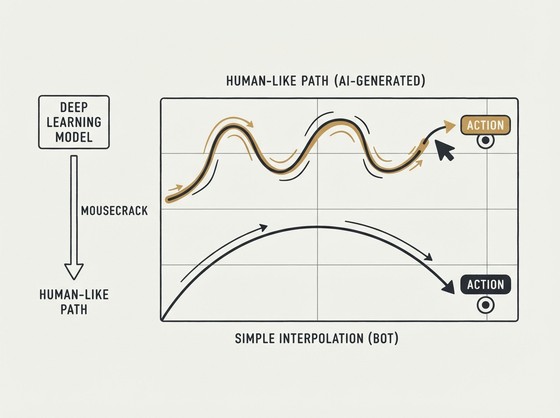
Bypass agent cursor detection using deep learning for mouse movement

Bypass agent cursor detection using deep learning for mouse movement

Bypassing bot detection using deep learning to simulate human mouse movements is a fascinating application that has just surfaced. This project, Mousecrack, generates organically varied mouse paths, moving beyond simple interpolation to truly human-like behavior.

The project offers an SDK and CLI, making it highly actionable for engineers working on automation, agents, or any system requiring realistic user interaction simulation. It provides a concrete example of applied AI solving a specific and challenging real-world problem.

This is not just about evading detection; it is about understanding and synthesizing complex human patterns with machine learning. It opens new avenues for testing and interacting with systems designed to detect non-human input.

Delegating bounded AI capacity to agents requires token sharing

Delegating bounded AI capacity to agents requires token sharing

The emerging challenge of managing AI capacity and access in multi-agent workspaces is getting a novel solution: sharing tokens, not API keys. This article introduces a system where AI agents possess their own cryptographic keys, enabling fine-grained, auditable delegation of resources.

Instead of agents borrowing human credentials, they operate with scoped identities, similar to how human teammates are granted access. This design allows for controlled allocation of AI allowances, ensuring proper attribution, easy revocation, and precise control over agent spending.

For architects building LLM infrastructure and multi-agent systems, this provides a compelling paradigm shift in security and resource management. It moves beyond traditional permission flags to a more robust, identity-based approach crucial for scalable and trustworthy AI deployments.
Making a Cache Cluster More Effective

Making a Cache Cluster More Effective

Optimizing a distributed cache cluster is more than just throwing more RAM at the problem. True effectiveness comes from deeply understanding access patterns and making intelligent design choices.

This article delves into strategies beyond basic caching, exploring how to leverage advanced eviction policies, ensure consistency across distributed nodes, and even rethink your network topology to maximize cache hit rates and minimize latency.

Engineers often reach for caching as a first solution, but building truly performant and resilient cache clusters requires a nuanced approach to distributed systems challenges. This provides actionable insights into those critical trade-offs.

Elevate your caching game from basic implementation to a strategic performance advantage.

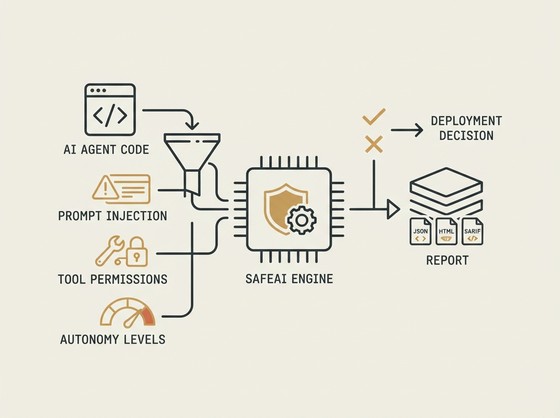
Static AI Agent Risk Analyzer for Pre-Deployment Detection

Static AI Agent Risk Analyzer for Pre-Deployment Detection

The wild west of AI agent deployment is about to get a much-needed layer of rigor. This new open-source project, SafeAI, brings static analysis principles to AI applications, specifically targeting agent capabilities and potential risks before they ever hit production.

Imagine catching prompt injection vulnerabilities, unintended tool permissions, or excessive agent autonomy during your CI/CD pipeline. SafeAI aims to do just that, generating detailed JSON, HTML, or SARIF reports to inform your deployment decisions.

This is not just about security; it is about responsible AI engineering. Integrating such a tool fundamentally changes how you reason about agentic AI safety and governance, moving from reactive debugging to proactive risk mitigation.

A crucial step for anyone building and deploying AI agents in the real world.

How self-contained AI agents automate marketing for multiple projects

How self-contained AI agents automate marketing for multiple projects

Running multiple small projects often means a never-ending marketing grind. This article reveals a brilliant, low-cost solution: self-contained AI marketing agents, costing just $40 per month for seven projects.

The core insight? Instead of a monolithic AI brain, each project gets its own agent living directly within its repository. This design choice dramatically reduces hallucinations and context mixing, a common pitfall with LLM agents handling diverse tasks.

By encapsulating the project’s facts, brand voice, and logs within its own agent’s context, the AI stays focused and effective. This is an engineering best practice applied to AI agent design, optimizing for both performance and cost.

A masterclass in pragmatic AI agent architecture for real-world business problems.

Technical Challenges and Solutions for Web Crawling at Scale

Technical Challenges and Solutions for Web Crawling at Scale

Scaling a web crawler to millions of documents is not just about raw ingestion speed; it is about surviving the absolute chaos of the open web. This article pulls back the curtain on the real-world engineering challenges faced when building a 40-worker crawling swarm and pushing a Solr index past 41 million documents.

You will learn how to tackle thorny issues like language redirection using proxy servers to bypass IP geo-location, effectively navigate “crawler tar pits” that trap lesser systems, implement robust NSFW and rich media filtering, and perform intelligent deduplication via canonical URLs. These are not theoretical problems but battle-tested solutions from someone actively in the trenches.

This provides actionable insights and architectural patterns for anyone dealing with large-scale data ingestion or building complex distributed systems, demonstrating that practical, in-the-weeds engineering can overcome immense hurdles.

An AI agent's high output questions traditional code review for small teams

An AI agent's high output questions traditional code review for small teams

Imagine shipping 108 PRs in eight days, not by sacrificing quality, but by strategically leveraging an AI agent. That is exactly what one engineer achieved, accidentally discovering what they call “loop engineering.”

The agent handles everything from picking tasks and writing code in an isolated worktree to getting CI green and responding to review feedback. This transforms the human role: instead of line-by-line code review, the engineer focuses on outcome-based testing and high-level strategy.

This approach challenges long-held engineering practices, particularly around mandatory human review for every line of code. It highlights how high-trust, small teams can redefine collaboration with autonomous agents, massively boosting throughput without compromising on quality for non-safety-critical code.

This is a real-world glimpse into the future of developer productivity and AI integration.

Minnarone framework enables real-time multimodal AI agent interaction

Minnarone framework enables real-time multimodal AI agent interaction

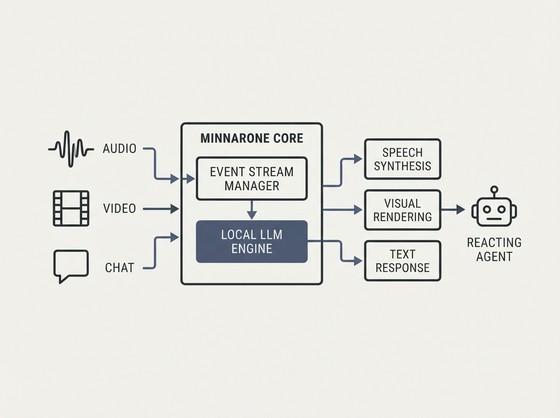
Building AI agents that perceive and react to the world in real-time, locally, is a massive technical challenge. This framework, Minnarone, tackles it head-on by allowing agents to process live multimodal context from audio, video, and chat.

The ‘fully local’ aspect is key here; it means developers can build sophisticated, context-aware agents without reliance on external cloud services for real-time inference. This implies clever engineering for managing data streams and executing LLM interactions on-device.

For anyone looking to dive into the practicalities of real-time agentic AI or develop robust multi-agent systems, this project offers a substantial starting point and a rich architectural blueprint. It is a genuine step towards more interactive and autonomous AI.

Agent-first display server enables secure human and AI GUI operation

Agent-first display server enables secure human and AI GUI operation

Imagine an operating system where AI agents and humans share the same GUI, but every interaction is capability-scoped and revocable. Vitrin OS introduces an “agent-first display server” that rethinks how AI interacts with traditional applications.

This project features a small, trusted core and a capability-native protocol. It confines legacy Wayland/X11 applications to their own isolated shims. This means fine-grained authorization for agents, journaling every action, and enabling unprecedented levels of security and control for automated GUI operations. It is a fundamental shift in how we approach human-agent collaboration and system security.

This is not just another framework; it is a deep dive into operating system architecture for the age of AI agents. It addresses a critical gap in enabling intelligent systems to operate real-world GUIs safely and effectively.

Opensmith is a local-first, open-source LangSmith alternative

Opensmith is a local-first, open-source LangSmith alternative

Frustrated with cloud-only LLM tracing tools? OpenSmith offers an open-source, local-first alternative to LangSmith, providing full visibility into your LLM pipelines without sending any data off your machine. It is designed for immediate use, requiring only a simple ‘pip install opensmith’ to get started.

This tool is a game-changer for privacy-conscious developers or those working in offline environments. It uses SQLite for local storage, eliminating the need for cloud accounts, complex setups, or Docker. You gain powerful debugging and optimization capabilities for any Python LLM pipeline.

OpenSmith makes LLM development more efficient by democratizing access to crucial tracing functionalities. It ensures that debugging your AI applications remains entirely within your control and local environment.

krouter ensures hitless multi-protocol routing for Kubernetes Gateway API

krouter ensures hitless multi-protocol routing for Kubernetes Gateway API

Deploying Kubernetes gateways often means grappling with custom CRDs and complex configurations. Krouter simplifies this by offering a fully compliant, Kubernetes-native Gateway API implementation that handles HTTP, gRPC, TCP, UDP, and TLS traffic without dropping connections during reloads.

This router is built on pure Gateway API v1.6.1, ensuring portability and avoiding vendor lock-in. Configuration changes apply atomically, guaranteeing zero downtime even during certificate rotations. It achieves this with just one tiny binary, reducing operational overhead significantly.

With 710 Gateway API conformance checks passed and a built-in dashboard for live traffic visibility, Krouter offers a robust, standards-first approach to Kubernetes networking. It is a powerful option for architects seeking simplified, resilient, and scalable ingress solutions.

AdaCTSi improves IoT time series imputation by adapting to changing environments

AdaCTSi improves IoT time series imputation by adapting to changing environments

IoT data is notoriously messy, especially with missing values in correlated time series. Existing imputation methods often fall short when environments change, sensors fail, or resources are constrained.

A new paper introduces AdaCTSi, a truly adaptive solution. It combines a One-shot Temporal Convolutional Network with a Learned Time-Sensor Index Table and Sparse Spatial Attention. This unique architecture decouples spatio-temporal features into sensor-wise embeddings, making it robust to varying sensor subsets and selective imputation.

The results are compelling: AdaCTSi reduces MAE by an average of 33.1 percent compared to the strongest baselines. What is more, it can be deployed on commodity computing devices, including MCUs, due to its modest memory footprint. This is a game changer for building resilient, on-demand AI in edge environments.

Concept2Scenario Framework Discovers LLM Refusal Vulnerabilities with Scenario Activation

Concept2Scenario Framework Discovers LLM Refusal Vulnerabilities with Scenario Activation

Ever wondered why some prompts bypass LLM safeguards? It is not always random. New research reveals that specific scenario-wrapped prompts activate ‘internal scenario directions’ that causally reduce refusal scores.

Concept2Scenario, a novel framework, can systematically uncover these vulnerable scenarios. It attributes refusal suppression to internal concepts, translates them into natural language explanations, and identifies powerful synergistic combinations. These insights significantly boost attack success rates and transfer across models, even to closed-source systems.

This is crucial for robust LLM deployment. Understanding these vulnerabilities mechanistically is the first step toward building truly safe AI.

A practical framework for selecting embedding models in retrieval systems

A practical framework for selecting embedding models in retrieval systems

Choosing the right text embedding model is one of the most critical, yet often under-examined, decisions in building effective retrieval systems. This report provides an invaluable, evidence-based framework to guide that choice.

It goes beyond simple benchmark scores, analyzing the entire journey from embedding production, through indexing and search at scale, to the crucial role of document chunking strategies. You will learn how to weigh task requirements, latency, cost, and deployment constraints.

If you are building RAG or search systems, this consolidated set of practical recommendations will save you countless hours and significantly improve your system’s quality.

Deep search evaluation requires understanding Delegation Intelligence

Deep search evaluation requires understanding Delegation Intelligence

Building reliable AI agents with “deep search” capabilities is incredibly hard because we often only measure end-to-end accuracy. But that lumps together whether the agent can retrieve information, understand long contexts, verify evidence, and intelligently decide when to search. This paper introduces “Delegation Intelligence” to untangle these.

They break it down into “Search Decision-Making” (recognizing information gaps, deciding to search, and choosing how) and “Information Synthesis and Verification” (aggregating evidence, judging reliability). The critical insight is that you cannot fix what you cannot measure in isolation.

By creating a controlled synthesis pipeline and benchmark, this work gives engineers a diagnostic toolkit. Instead of guessing why an agent fails, you can pinpoint if it struggles with knowing when to invoke a tool, or if it is unable to synthesize retrieved information effectively. This is a game-changer for debugging and improving RAG-based agent systems in practice.

Compositional runtime verification detects swarm mission failures

Compositional runtime verification detects swarm mission failures

Ensuring safety in LLM-assisted multi-agent systems, like robot swarms, is not just about each agent behaving correctly. A major challenge is detecting mission-level violations where individually compliant actions combine to break a global rule. Think of agents splitting a prohibited task to fly under the radar.

This paper introduces a sophisticated three-tier compositional runtime-verification framework. It decomposes mission policies, aggregates verdicts over a “verification-aware messaging fabric,” and uses an evidence-aware algebra. This fabric is critical because it explicitly accounts for lost or delayed evidence in contested communication environments.

The key takeaway is that traditional per-platform guardrails are insufficient. You need a system that observes communication silence and evidence loss, downgrading unsupported negative verdicts to “unknown” rather than false “all-clears.” This approach promises to make LLM-assisted swarms far more robust and auditable for critical applications.

State-bound model ensures authorization continuity for evolving AI agents

State-bound model ensures authorization continuity for evolving AI agents

Long-lived AI agents that learn and evolve pose a significant authorization problem. As agents acquire new skills and delegate tasks, how do you ensure they remain within the bounds of what was initially authorized?

This paper introduces a critical concept: authorization continuity. It proposes a state-bound model with an immutable “effect ceiling” to prevent agents from amplifying protected effects beyond user-issued limits, even as they evolve.

If you are building or deploying autonomous agents, understanding this framework is crucial for maintaining security and trust. It is a fundamental piece of the puzzle for robust, production-ready agent systems.

Router-side injection significantly alters coding agent actions

Router-side injection significantly alters coding agent actions

Are you using third-party API routers for your coding agents? You might have a critical security vulnerability. These routers sit in the trusted path, inspecting and modifying every request and response, yet there is no mechanism to verify alignment between provider output and the agent’s ultimate actions.

An empirical study revealed that router-side injections can substantially alter repository-level actions, with all evaluated agents achieving a 0 percent defense success rate against these attacks. Even client-side mitigations are largely ineffective.

This is not a theoretical risk; it is a measured, practical flaw. For senior engineers building agent systems, this paper highlights a severe control gap that demands immediate attention for secure infrastructure design.

SpecAHD is a bilevel framework for within-instance heuristic specialization

SpecAHD is a bilevel framework for within-instance heuristic specialization

Tackling large-scale routing problems with automated heuristic design (AHD) is a significant challenge. LLM-based AHD typically compromises across varied repair regions within an instance. What if you could specialize the heuristics to the local context?

SpecAHD introduces a novel bilevel framework that does exactly this. An upper-level search identifies bounded repair regions, while a lower-level search evolves a specialized repertoire of executable heuristics for those specific tasks.

This approach reduced objective costs by up to 57.7 percent against strong baselines. If you are solving complex optimization problems, SpecAHD offers a sophisticated way to leverage LLMs for deep, context-aware heuristic generation.

Attention Orchestration improves multi-agent LLM systems by dynamic resource allocation

Attention Orchestration improves multi-agent LLM systems by dynamic resource allocation

Scaling multi-agent systems quickly hits a wall with inefficient resource allocation, as agents waste compute on irrelevant tasks. This paper introduces “Attention Orchestration,” a paradigm shifting how we think about agent coordination.

The Adaptive Goal-aware Attention Orchestration (AGAO) framework dynamically prioritizes agents. It combines goal-aware attention, understanding semantic relevance; topology-aware attention, mapping structural dependencies; and resource-aware attention, allocating budgets. This transforms static agent graphs into adaptive, efficient systems.

Experiments show AGAO significantly boosts task effectiveness while cutting unnecessary computation, latency, and token consumption. For engineers building complex agent workflows, this is a critical step towards scalable, intelligent multi-agent systems, moving beyond uniform execution to truly focused computation.

This is not just a tweak, it is a new way to engineer agent attention.

Cached rows semantically materialize computation views when inputs are gone

Cached rows semantically materialize computation views when inputs are gone

Long-horizon AI agents rely heavily on reusing their KV cache as memory, but we rarely question if those retained events are truly informative once the originating observations are gone. This paper rigorously tests that premise, revealing fascinating insights into how LLMs ‘remember.’

The key finding is “semantic materialization”: cached rows from a downstream event can act as an independently servable view of computation even when their inputs are gone. This is a powerful concept for agent memory, showing that compact, deliberately phrased states survive, while larger payloads decay towards chance.

This leads to a “memory contract” for sparse event-KV serving, detailing what to write, where it lands, and what survives. For anyone building sophisticated agent systems, understanding this contract is crucial for designing effective eviction policies and robust, persistent agent memory.

It changes how we should think about agent state.

WISERouter Improves LLM Routing by Constrained Multi-Armed Bandit

WISERouter Improves LLM Routing by Constrained Multi-Armed Bandit

Deploying large language models at scale means constantly battling the trade-off between model capability and cost. Using the most powerful LLM for every query is simply prohibitive. WISERouter presents a sophisticated framework to optimize this critical problem: LLM routing.

This paper frames LLM routing as a constrained contextual multi-armed bandit problem, which is a powerful way to balance utility and budget across an entire workload, not just per-query. It introduces both offline learning from historical interactions and online learning with exploration, complete with a sublinear regret bound.

WISERouter outperforms existing heuristics in performance under budget and adheres much more closely to budget constraints, all while requiring substantially less exploration data. For any senior engineer managing LLM inference infrastructure, this framework provides a robust, data-driven approach to optimize your LLM costs and latency.

Smart LLM routing is now a science, not just an art.

Scaled weight decay preserves optimization targets and speeds up training

Scaled weight decay preserves optimization targets and speeds up training

The discovery of scaling laws has pushed us to train larger models on more data, often with a constant decoupled weight decay. This standard practice can cause model weights to shrink steadily throughout training.

A new paper suggests a clever twist: scale weight decay by the fraction of the peak learning rate. This small change, often just a few lines of code, preserves crucial asymptotic stationarity guarantees that constant weight decay disrupts.

The practical impact is substantial. For Mixture-of-Experts models, this method can accelerate pre-training by 30 percent. That is a massive saving in compute and time, directly applicable to anyone building or refining large language models. It is a simple hyperparameter tweak with profound effects.

ARCHITECT enables steerable robot policies via LLM program synthesis

ARCHITECT enables steerable robot policies via LLM program synthesis

Black-box vision-language-action models are powerful, but their lack of interpretability and adaptability is a major hurdle for real-world robotics. When they fail, it is hard to know why or how to correct them.

ARCHITECT tackles this by treating robot policy acquisition as an interactive program synthesis task, driven by LLM coding agents. Instead of opaque end-to-end policies, it generates modular robot programs that use discrete perception and control tools.

This modularity means human supervisors can provide natural language corrections, localizing feedback and distilling successful behaviors into a persistent skill library. This approach allows the system to accumulate reusable, interpretable skills, offering a steerable and data-efficient alternative to purely black-box learning for complex, long-horizon tasks.

Task transformation extends verifiable reinforcement learning to open-ended problems

Task transformation extends verifiable reinforcement learning to open-ended problems

A major roadblock in applying Reinforcement Learning to LLMs for open-ended tasks is the lack of deterministically verifiable rewards. Current methods often rely on human preferences or imperfect reward models, leading to bias and scalability issues.

Introducing Reinforcement Learning with Self-Verifiable Rewards (RLSVR), a clever task-transformation paradigm. This approach turns open-ended problems into proxy environments with internal rules that automatically generate verifiable rewards.

One implementation, SpyRL, uses a multi-agent self-play game inspired by ‘Who Is the Spy?’. Agents receive asymmetric information and vote, with predetermined spy identities providing fully verifiable rewards. This unlocks scalable RL-based self-improvement for areas like creative writing and summarization, where direct correctness metrics are elusive. It is a significant step towards more autonomous and effective LLM agents.

Agentic Context Management enables lossless context editing for longer agent explorations

Agentic Context Management enables lossless context editing for longer agent explorations

Tired of LLM agents losing their way in long, complex tasks due to context window limits? A new framework, Agentic Context Management (ACM), offers a novel solution by equipping agents with lossless context editing tools, much like human short-term and long-term memory.

This framework allows agents to autonomously decide when to compress context, offload less immediately relevant information to an external memory, and then retrieve it precisely when needed. This intelligent management drastically reduces peak token pressure and enables much longer, more consistent explorations in tasks like agentic search and coding.

The results are significant: improved performance on real-world agentic tasks and more stable solutions across trials. This is not just a theoretical improvement; it is a practical blueprint for building more capable and reliable AI agents by solving one of their most persistent limitations.

TriShieldRAG defends retrieval-augmented generation from adversarial document poisoning

TriShieldRAG defends retrieval-augmented generation from adversarial document poisoning

RAG systems are powerful, but their reliance on external knowledge bases makes them dangerously vulnerable to poisoned documents. A single adversarial entry can steer an LLM toward a wrong answer nearly 90 percent of the time. This is a critical production problem.

Introducing TriShieldRAG, a comprehensive defense-in-depth framework that uses three independent rings to protect against knowledge corruption. First, an Ingest Guard screens documents for malicious signatures. Second, a Retrieval Scorer re-ranks results based on a trust score weighted by provenance and consistency. Third, a Cross-LLM Consensus stage polls multiple models and triggers re-retrieval on disagreement.

This multi-layered approach is not just theoretical; it has been shown to reduce attack success rates from 91 percent down to approximately 13 percent, while preserving accuracy on benign queries. It is a vital blueprint for any engineer building or deploying RAG systems, ensuring your knowledge base remains a source of truth.

Particle-based method learns feature distributions for improved kernel machines

Particle-based method learns feature distributions for improved kernel machines

Linearized Transformer attention offers impressive efficiency for large language models, but its performance often hinges on the choice of feature distribution. What if the model could learn these features dynamically, making itself more robust and accurate?

This paper introduces a “Coulomb particle model” that does exactly that. It learns optimal kernel attention features by optimizing for kernel-target alignment, simultaneously using a repulsive potential to ensure feature diversity. The method integrates directly into linearized Transformers.

The results are compelling: improved accuracy, better calibration, and enhanced robustness, all while preserving the speed advantages of linear attention. For engineers building custom Transformer architectures or optimizing LLM inference, this presents a significant leap forward in designing more performant and stable attention mechanisms.

MulRobBench reveals multimodal models struggle with trustworthy UAV decisions

MulRobBench reveals multimodal models struggle with trustworthy UAV decisions

Deploying AI agents in safety-critical domains like smart-city UAVs demands more than just perception and navigation; it requires strict adherence to security policies and risk-aware decision making. Current benchmarks often fall short in evaluating these complex, real-world constraints.

MulRobBench is here to close that gap. This new decision-level benchmark for multimodal UAV agents integrates real-world observations, protocol-level security policies, and cyber-physical safety directly into its evaluation framework. It assesses operational context understanding, multimodal evidence arbitration, degradation-aware reasoning, and risk-aware action planning across 12 dimensions.

The initial results from 17 multimodal models are sobering, with the best semantic decision score barely reaching 0.51. This highlights the immense challenge in building trustworthy, policy-compliant AI agents for complex environments. It is a critical tool for any engineer pushing the boundaries of real-world AI agent deployment.

MCP offers lightweight coordination; A2A provides richer, complex state management

MCP offers lightweight coordination; A2A provides richer, complex state management

Building robust multi-agent systems with LLMs? The choice of inter-agent coordination protocol is critical, and a new study sheds light on the trade-offs between MCP and A2A.

The Model Context Protocol (MCP) offers a lightweight implementation model, ideal for constrained LLM-based systems, though managing conversational state and task lifecycles falls to the application layer. This can reduce coordination complexity at the protocol level.

In contrast, the Agent2Agent (A2A) protocol provides richer native support for stateful, multi-turn conversations with protocol-level abstractions for tasks and lifecycle management. However, this comes with substantially greater implementation complexity.

Understanding these trade-offs is crucial. Engineers must weigh whether explicit application-level state management with MCP or robust, protocol-driven state management with A2A better suits their agentic system’s requirements and complexity tolerance. This is not just theoretical; it impacts development velocity and system maintainability.

Pick your agent coordination wisely to avoid future headaches.

Multi-level LLM approach Optimo efficiently optimizes dynamic language code

Multi-level LLM approach Optimo efficiently optimizes dynamic language code

Imagine an LLM that not only generates code but optimizes it at multiple levels, from algorithmic improvements to fine-grained API usage. Optimo, a new framework, does exactly this, and the results are compelling.

Optimo employs a ‘Mixture-of-Prompts’ (MoP) architecture, identifying performance bottlenecks through differential profiling. It then routes these time-critical sections to specialized optimization prompts, akin to expert models. This multi-level approach is key.

Instead of generic, single-pass optimization, Optimo tackles issues from high-level algorithmic changes down to more efficient API calls. This leads to impressive speedups, with up to 57.48% of optimized programs becoming at least 10% faster and achieving up to 3.97x speedup on human-written code.

This showcases a practical path for LLMs to move beyond mere code generation to actual performance engineering. It is not just about writing code, but writing efficient code, making this a powerful tool for enhancing developer productivity and application performance.

A significant step towards genuinely intelligent coding assistants.

Decomposing relevance into likelihoods and priors improves retrieval systems

Decomposing relevance into likelihoods and priors improves retrieval systems

Modern information retrieval and RAG pipelines are often seen as monolithic, but what if we could rethink relevance itself? A new paper proposes viewing it as approximate posterior inference, separating query-dependent likelihoods from query-independent priors.

This decomposition is not just theoretical; it has significant practical implications. By explicitly modeling document utility offline, you can shift substantial computation out of the critical query-time path. This means faster and more efficient retrieval.

Empirical evidence shows tangible benefits: incorporating a learned prior improves first-stage retrieval with rank fusion (up to 0.046 nDCG@10) and boosts downstream re-ranking, especially for LLM re-rankers like RankZephyr (up to 0.054 nDCG@10).

This approach offers a principled way to optimize multi-stage ranking, recommendation, and retrieval-augmented generation systems. It moves beyond simple scoring to a more nuanced, computationally aware design.

Rethinking how we model relevance can unlock new levels of performance and efficiency in information access.